
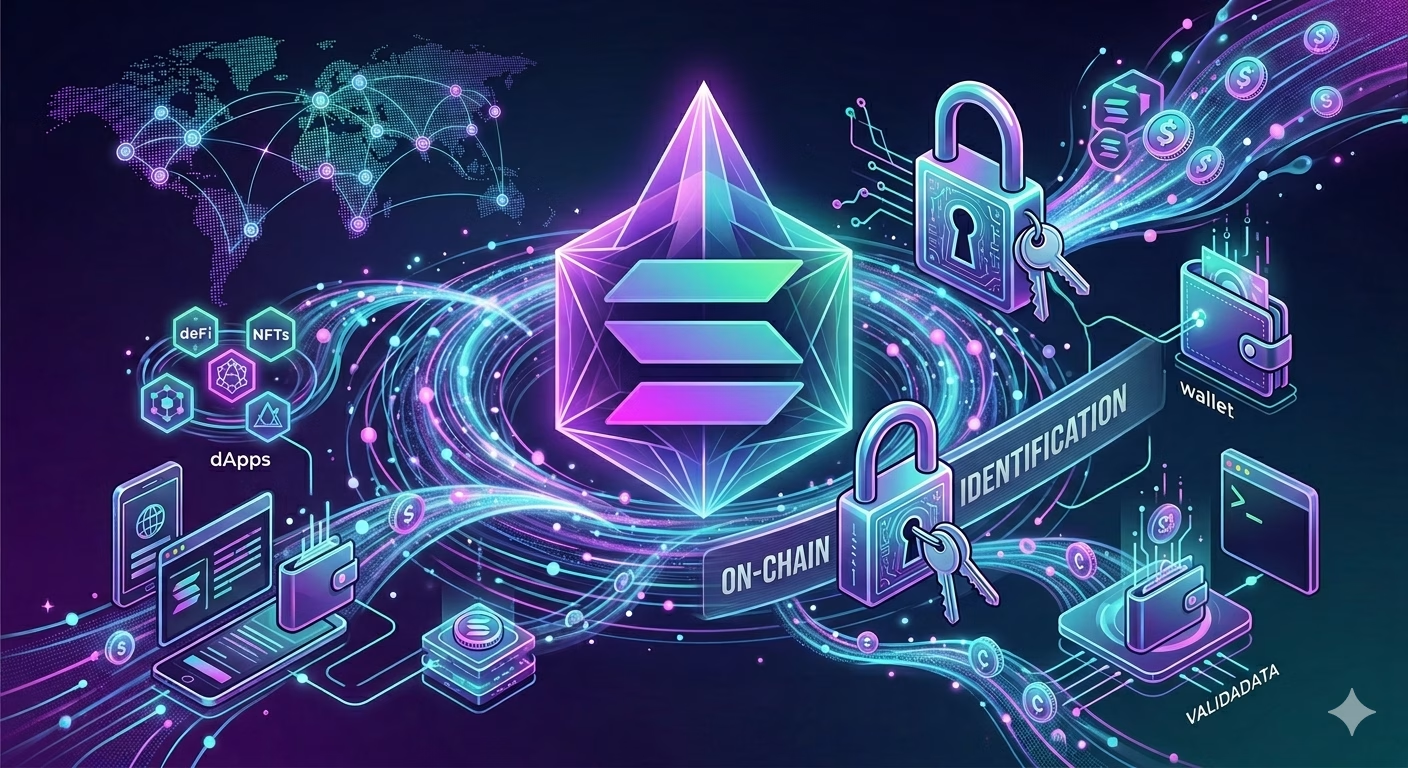
Exploring Web 3.0 and How Solana Handles Identity
From Web 2.0 to Web 3.0, identity remains an important aspect for authentication and authorization for both users and the server owners. However, the underlying architecture is shifting. In Web 2.0, we rely on usernames and passwords stored on server owner’s hardware or handled by SSO vendors like Auth0, Google or Microsoft. On the other hand, in Web 3.0 we swap databases for cryptographic keys. In this post, we’ll dive into how the Solana network uses these keys for On-Chain Identification.
The Key-pair: Your New Credentials
Solana is a high-performance network powering decentralized finance (DeFi), NFTs and decentralized applications (dApps). Unlike traditional systems where a server “owns” your identity, Solana uses a Public Key as your unique address.
Think of it this way:
- Public Key (Your Username): A unique 32-byte address. This is what people use to send you tokens.
- Private Key (Your Password): A digital signature that stays on your personal device. You use this to “sign” and authorize transactions.
Ed25519 vs. PDAs
Wallets usually use the Ed25519 digital signature, with the exception of Multisig Wallets or Smart wallets (Escrows, etc.). When you create an account, it must be accompanied by a private key that you or a secure third-party vendor maintains.
Solana uses PDAs (Program Derived Addresses), which are unique addresses that are not associated with a private key. Instead, they rely on a Program ID and specific seeds like user ID or user public key for authentication. This allows programs to programmatically sign for accounts. We can think of it like a service account in a cloud environment.
Beyond Usernames: What Identity Enables
On-chain identity isn’t just a replacement for a login, it’s a self-custodied foundation for:
- Token Ownership: Proving what assets you hold.
- Governance: Your right to vote on protocol changes.
- Reputation: Your history on the public ledger is permanent and verifiable.
Because this is cryptographic, it works across every application on the network without needing server permission or an API integration. Your identity allows you to be discovered on the network, receive tokens, and maintain a wallet assignment globally.
The Math: SOL and Lamports
Once you have your identity, you’ll interact with SOL, Solana’s native cryptocurrency. Programmatically, we don’t usually work in whole SOL, we work in Lamports. Lamports are SOL’s smallest fractional unit.
1 SOL = 1,000,000,000 (10⁹) Lamports.
Think of Lamports as cents or pennies and SOL as dollars. This allows for high-precision transactions without the floating-point errors we try to avoid in financial code.
Conclusion: Who Owns The Server?
The biggest shift from Web 2.0 to Web 3.0 is ownership. In Web 2.0, there is one true owner: the entity hosting the servers. In Web 3.0, the network is decentralized and hosted across the globe.
We’d love to hear your feedback on this research in the comments below.
Key Features of On-Chain Identity Systems
Building applications on decentralized networks like Solana requires rethinking traditional identity systems. Instead of relying on centralized databases, developers must design around cryptographic ownership and trustless interactions. Key elements include:
- Self-Custody: Users control their own private keys, eliminating reliance on centralized authentication providers.
- Secure Signing: Transactions and interactions are verified through cryptographic signatures rather than passwords.
- Interoperability: A single wallet identity works across multiple dApps without requiring separate accounts or logins.
- Transparency: Public keys allow verifiable interaction history while maintaining pseudonymity.
- Programmatic Control: Smart contracts and PDAs enable automated and trustless account management.
Leveraging On-Chain Identity in Applications
On-chain identity unlocks new possibilities for developers and users by shifting trust from centralized servers to verifiable code. By integrating wallet-based authentication and program-driven accounts, applications can provide:
- Trustless Authentication: Users verify themselves by signing transactions instead of sharing credentials.
- Unified User Experience: One wallet can access multiple platforms without repeated registrations.
- Permissionless Access: Anyone with a wallet can interact with applications without needing approval from a central authority.
- Composable Systems: Applications can build on top of each other using shared identity standards.

How Our Team Can Support Your Web3 Journey
As Web3 continues to evolve, many teams are exploring how concepts like on-chain identity and decentralized applications fit into their existing products. At Phonic Solutions, we take a practical, consultation-first approach to help you navigate this space with clarity.
- Exploration & Strategy: Helping you understand where blockchain and on-chain identity can (or cannot) add value to your product.
- Prototyping & MVPs: Building lightweight proofs-of-concept to test ideas before committing to full-scale development.
- Wallet & Auth Integration: Assisting with the integration of wallet-based login flows alongside or in place of traditional authentication.
- Bridging Web2 and Web3: Connecting existing applications to decentralized components without requiring a complete rebuild.
- Security Awareness: Advising on best practices around key management, transaction signing, and user safety.
- Ongoing Guidance: Supporting your team as the technology and your use case continue to evolve.
Web3 is still an emerging space, and not every problem needs a blockchain solution. Our goal is to help you make informed decisions, experiment responsibly, and build only where it truly makes sense. Whether you’re curious about integrating on-chain identity or just exploring the possibilities, our web development team is here to guide you.
Curious about how Web3 concepts like on-chain identity could fit into your product or business? Let’s have a conversation. We’re happy to explore your ideas, answer questions, and help you evaluate what makes sense for your goals.
You can reach out to us at https://phonicsolutions.com/contact or learn more about our work at https://phonicsolutions.com.

